「INTRO」 WHAT COMES FIRST
For those reading these pages who are familiar with the culture and history of contemporary graphic design (and here we specify a certain type of history situated in a certain type of world), Meme Things First will seem like a rather self-explanatory wordplay. The explicit intention, which is as programmatic as it is naughty, is to subvert the manifesto-like tone with which critical discourse in graphic design has long been constructed: not so much to demolish it, but to collectively question its trajectories, cracks and paradoxes. It is no coincidence that what we will be dealing with in these pages has a lot to do with parody1, that ancient form of ironic reversal which, since Aristophanes, has transformed reality into a space for shared reflection. The allusion is to the First Things First manifesto, written by Ken Garland in 1964 together with twenty other designers, photographers and students. It is a milestone in the evolution of the political and social consciousness of graphic designers. The content of the manifesto, conceived during a conference of the Society of Industrial Artists in London, is one of the first cases of reflection and redefinition of their professional role in relation to the advertising market, an “insignificant purpose”, according to Garland himself, a source of frustration for talent and imagination. Certainly, this is not yet a total opposition to the capitalist system, but rather a proposal for a critical way of moving within the system itself: no longer “cat food” or “cigarettes”, but “signs for streets and buildings, [...] instruction manuals, [...] educational aids”2. What makes this call for a more ethical stance so important is not only the message itself, but the echo it has had over time. Thanks to its publication in a Guardian column, Garland was invited to read it on television during an episode of the BBC’s Tonight programme3, and from then on, numerous magazines, including the Royal College of Arts magazine, republished it, translating it into French and German and taking it far beyond the borders of the UK.
A chi, tra coloro che leggono queste pagine, non è a digiuno di cultura e storia della grafica contemporanea (e qui specifichiamo, un certo tipo di storia situata in un certo tipo di mondo), Meme Things First risulterà come un gioco di parole piuttosto autoesplicativo. L’intenzione dichiarata, programmatica quanto dispettosa, è quella di sovvertire l’intonazione manifestale con cui si è a lungo costruito il discorso critico nel graphic design: non tanto per demolirlo, quanto per interrogarne collettivamente le traiettorie, le crepe e i paradossi. Non a caso, quello di cui ci occuperemo in queste pagine ha molto a che fare con la parodia1, ovvero quella forma antica di rovesciamento ironico che, da Aristofane in poi, trasforma la realtà in spazio di riflessione condivisa. L’allusione è al manifesto First Things First, scritto da Ken Garland nel 1964 insieme a venti altri designer, fotografe e studenti. Si tratta di una tappa fondamentale nell’evoluzione della coscienza politica e sociale dei progettisti. Il contenuto del manifesto, ideato durante un convegno della Society of Industrial Artists a Londra, è uno dei primi casi di riflessione e ridefinizione del proprio ruolo professionale in relazione al mercato pubblicitario, uno “scopo insignificante”, secondo lo stesso Garland, fonte di frustrazione per il talento e l’immaginazione. Non si può ancora certamente parlare di una contrapposizione totale al sistema capitalistico, quanto la proposizione di un modo critico con il quale muoversi all’interno del sistema stesso: non più “cibo per gatti” o “sigarette”, ma “cartelli stradali, [...] manuali di istruzioni, [...] strumenti didattici”2. Ciò che rende questo appello a una presa di posizione più etica un episodio imprescindibile non è soltanto il messaggio in sé, quanto l’eco che ha avuto nel corso del tempo. Grazie alla sua pubblicazione su una colonna del Guardian, Garland è stato invitato a leggerlo in televisione durante una puntata del programma Tonight della BBC3, e da quel momento in poi numerose riviste, tra cui il magazine del Royal College of Arts, lo hanno ripubblicato, traducendolo in francese e tedesco e facendolo viaggiare ben oltre i confini territoriali britannici.
Then, in 1999, the environmental organization Adbusters relaunched an updated version of the iconic poster, entitled First Things First 2000. This time it was signed by “graphic designers, art directors, and visual communicators”4 of the stature of Irma Boom, Max Bruinsma, Steven Heller, Zuzana Licko, Ellen Lupton, Jan van Toorn, and Garland himself, among others. The text, which, echoing the positions of 40 years earlier, emphasized a deeper split from the industrial world and the need to focus the discipline’s attention on “environmental, social, and cultural crises”5, had a huge impact within the sector and was republished by magazines such as Eye, Items, Form, Blueprint, as well as the AIGA Journal of Graphic Design. In its reformulation, the manifesto is transformed from a moral appeal into what we might call a narrative topos: each new generation of designers seems to find itself, cyclically, rearticulating the urgency of its practice, oscillating between political denunciation, intellectual stance, and stubborn reformulation. In this context, First Things First certainly does not exhaust the variety of positions that run through the history of design, but what it does is point the finger at a crucial, unresolved, and by its very nature probably unsolvable issue: the divide between an ideal profession and a profession embedded in reality. Like a common thread, this legacy reemerges, with different forms and objectives, in the many critical instances that have tangentially and incidentally crossed the discipline: a thread that reappears in different episodes and seasons, from critical and speculative design to the most recent practices that question the possibility of “designing otherwise”6.
È poi il 1999 quando l’organizzazione ambientalista Adbusters rilancia una versione aggiornata dell’iconico manifesto, dal titolo First Things First 2000. Questa volta è firmato da “graphic designers, art directors e comunicatori visivi”4 del calibro, tra gli altri, di Irma Boom, Max Bruinsma, Steven Heller, Zuzana Licko, Ellen Lupton, Jan van Toorn, insieme allo stesso Garland. Il testo, che, riprendendo le posizioni di 40 anni prima, rimarca una più profonda scissione dal mondo industriale e la necessità di concentrare l’attenzione della disciplina sulle “crisi ambientali, sociali e culturali”5, ha avuto moltissima risonanza all'interno del settore, ripubblicata da magazine come Eye, Items, Form, Blueprint, così come dall'AIGA Journal of Graphic Design. Nella sua riformulazione, il manifesto si trasforma da appello morale a quello che potremmo chiamare un topos narrativo: ogni nuova generazione di designer sembra trovarsi, ciclicamente, a riarticolare l’urgenza della propria pratica, oscillando tra denuncia politica, postura intellettuale e ostinata riformulazione. In questo quadro, First Things First non esaurisce certo la varietà di posizioni che attraversano la storia del design, ma quello che fa è puntare il dito contro uno snodo cruciale, irrisolto, e per sua natura probabilmente irrisolvibile: la frattura tra una professione ideale e una professione calata nel reale. Come un fil rouge questa eredità riemerge, con forme e obiettivi differenti, nelle molteplici istanze critiche che hanno attraversato, tangenzialmente e incidentalmente, la disciplina: un filo che ricompare in puntate e stagioni diverse, dal design critico e speculativo alle più recenti pratiche che interrogano la possibilità di “progettare altrimenti”6.
In a genealogy that reveals both the vitality and the impasse of a field that never stops looking at itself in the mirror, the classroom appears to be the most direct reflection of this fracture. It is precisely there, in contact with the real conditions of education, that the distance between the two poles manifests itself forcefully, leaving traces that only become fully intelligible in a retrospective light. Every fluctuation in the self-reflective debate has had a greater impact on the educational landscape than historiography tends to recognise: what appears as a discursive change in the wider field often finds its most pronounced echo and its operational laboratory in educational institutions. It is an autopoietic7process: design produces the narratives that explain it, shapes the categories that judge it, and establishes the boundaries that in turn restrict its agency. And this mechanism intensifies precisely where the discipline becomes an institution, that is, in the classroom.
In una genealogia che rivela tanto la vitalità quanto l’impasse di un campo che non smette di guardarsi allo specchio, l’aula appare come il riflesso più diretto di questa frattura. È proprio lì, a contatto con le condizioni reali della formazione, che la distanza tra i due poli si manifesta con forza, lasciando tracce che diventano intelligibili appieno solo retrospettivamente. Ogni fluttuazione del dibattito autoriflessivo ha inciso sul paesaggio educativo più di quanto la storiografia tenda a riconoscere: ciò che compare come un mutamento discorsivo nel campo allargato trova spesso nelle istituzioni scolastiche la sua eco più pronunciata e il suo laboratorio operativo. È un processo autopoietico7: il design produce le narrazioni che lo spiegano, modella le categorie che lo giudicano, istituisce i confini che poi a loro volta restringono la sua agentività. E questo meccanismo si intensifica proprio laddove la disciplina si fa istituzione, cioè nello spazio della classe.
During the 20th century, design schools became part of the university system, transforming a workshop tradition into a stable educational institution capable of attracting growing numbers of students. The arrival of the personal computer between the late 1980s and late 1990s further amplified this process: the democratisation of tools and the accessibility of software contributed to a real boom in enrolments, accompanied by the proliferation of three-year courses, master’s degrees, summer schools and intensive programmes at an international level. This is where Rob Giampietro’s point in School Days8 comes in, when he observes that the growth of educational institutions and that of critical debate are not parallel phenomena, but intertwined. For Giampietro, the culture of design in the 2000s is beginning to resemble more and more the culture of the schools that produce it: conferences, talks, workshops, online forums and “lifelong learning” spaces have ended up transforming the entire disciplinary ecosystem into an extension of the campus, generating a sort of widespread pedagogization of discourse. These, writes Giampietro, could be remembered as the true “school days” of design.
Nel corso del XX secolo, le scuole di design sono entrate nel sistema universitario, trasformando una tradizione laboratoriale in un dispositivo pedagogico stabile, capace di attirare numeri crescenti di studentx. L’arrivo del personal computer, tra la fine degli anni Ottanta e i tardi anni Novanta, ha amplificato ulteriormente questo processo: la democratizzazione degli strumenti e l’accessibilità del software hanno contribuito a un vero boom di iscrizioni, accompagnato dal proliferare di corsi triennali, magistrali, summer schools e programmi intensivi a livello internazionale. È qui che si colloca il nodo messo a fuoco da Rob Giampietro in School Days8, quando osserva che la crescita delle istituzioni educative e quella del dibattito critico non sono fenomeni paralleli, ma intrecciati. Per Giampietro, la cultura del design degli anni Duemila inizia a somigliare sempre più alla cultura delle scuole che la producono: conferenze, talk, workshop, forum online, spazi di “apprendimento permanente” hanno finito per trasformare l’intero ecosistema disciplinare in un’estensione del campus, generando una sorta di pedagogizzazione diffusa del discorso. Questi, scrive Giampietro, potrebbero essere ricordati come i veri “school days” del design.
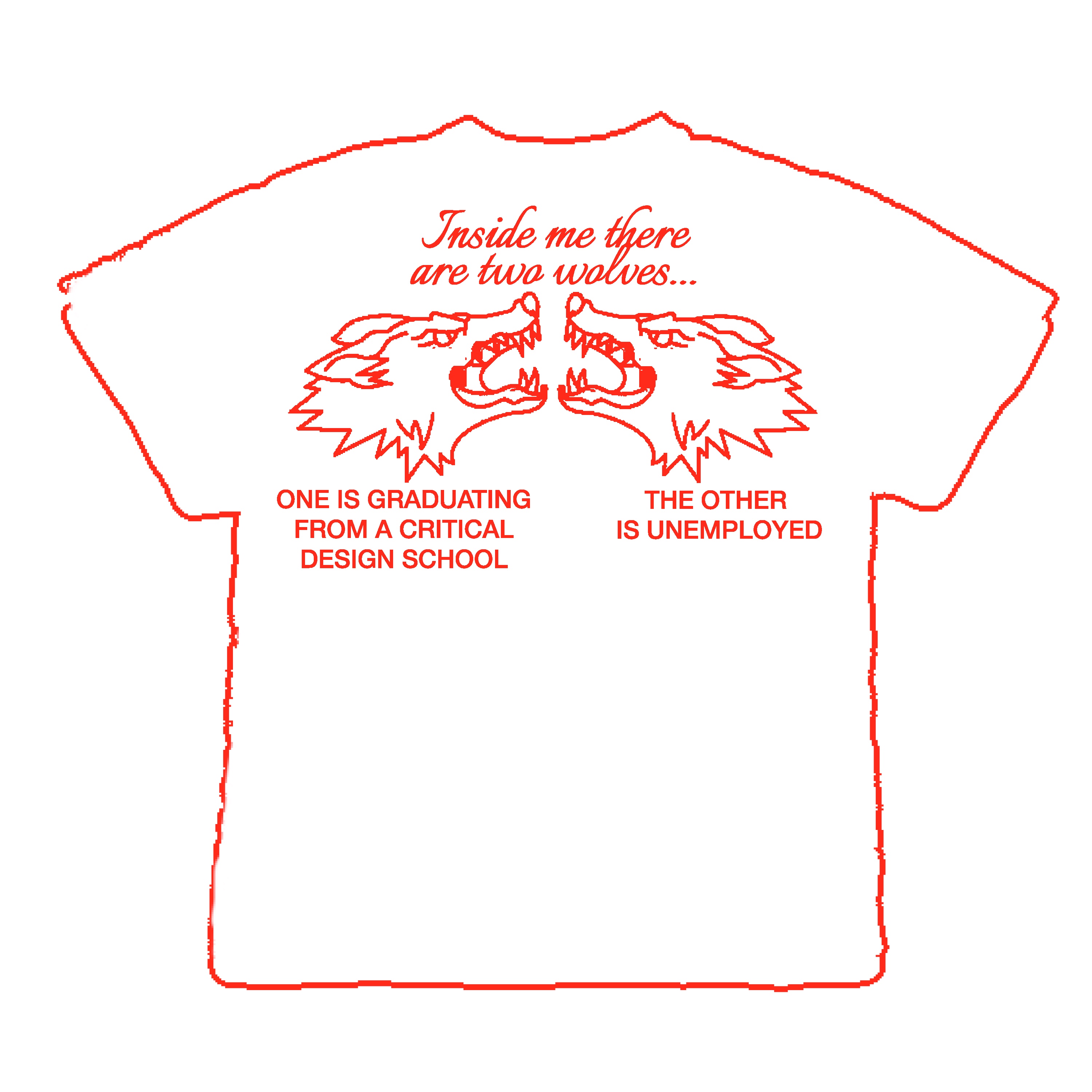
The two wolves identified by Afonso de Matos.
I due lupi identificati da Afonso de Matos.
However, the most significant fact is that, in this scenario, the school is not only a structure that exposes the tensions in the field: it is their most obvious embodiment. The two “wolves”9 identified by Afonso de Matos, namely the drive towards criticism as a form of emancipation and the difficulty of translating it into practice. Faced with this contradiction, the question of who has the resources, the time, the symbolic capital to transform criticism into practical action and not just language? It is a question that the discipline touches on cyclically, but which becomes urgent when we observe the effects that these attitudes produce in the generations being educated.
Ma il dato più significativo è che, in questo scenario, la scuola non è solo una struttura espositiva delle tensioni del campo: è la loro incarnazione più evidente. I due “lupi”9 individuati da Afonso de Matos, ovvero la spinta verso una critica come forma di emancipazione e la realtà materiale, precaria, in cui questa stessa critica deve potersi sostenere, trovano proprio nell’aula il loro conflitto più netto. Chi può permettersi di essere critich3? Chi dispone delle risorse, del tempo, del capitale simbolico per trasformare la critica in pratica progettuale e non soltanto in linguaggio? È una domanda che la disciplina sfiora ciclicamente, ma che diventa urgente quando si osservano gli effetti che queste posture producono nelle generazioni in formazione.
As early as 1997, Dutch designer Van Toorn realised that schools offer an excellent space for reflective and operational research, as they are located on the “periphery of the global media spectacle”10. It is there that alternative practices can be developed, he claimed, because educational institutions ideally offer students the tools to perceive, reflect, criticise and transform. But this very peripheral position, potentially emancipatory, also exposes a structural vulnerability: the tension between what the school declares and what the school allows11.
Il designer olandese Van Toorn, già nel 1997, aveva intuito che le scuole offrono uno spazio eccellente per una ricerca riflessiva e operativa, in quanto posizionata alla “periferia dello spettacolo mediatico mondiale”10. È lì che si possono sviluppare pratiche alternative, diceva, perché le istituzioni educative idealmente offrono all3 student3 gli strumenti per percepire, riflettere, criticare e trasformare. Ma proprio tale posizione periferica, potenzialmente emancipatrice, espone anche una vulnerabilità strutturale: la tensione tra ciò che la scuola dichiara e ciò che la scuola permette11.
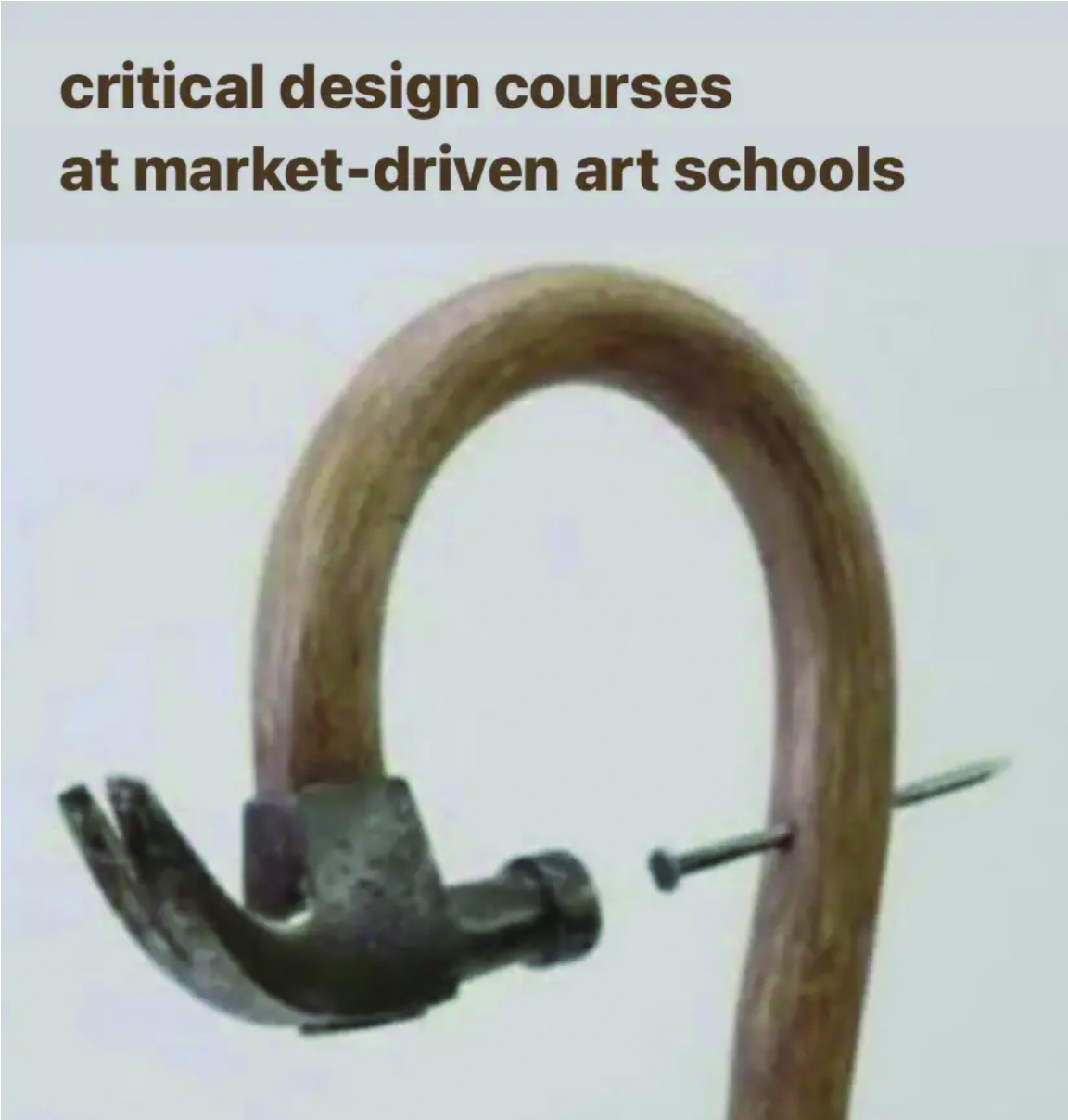
Found image. https://www.instagram.com/p/C2fCiHlIEBq/?img_index=5.
Immagine trovata. https://www.instagram.com/p/C2fCiHlIEBq/?img_index=5.
The fact that students play a role in this narrative, sometimes actively, sometimes implicitly, is evident from the very first episode of our genealogy. Take, for example, First Things First, which was also signed by some students: a circumstance that is often underestimated, but which indicates how the dynamic between the classroom and the profession has always been circular. But how, in practical terms, do students make their voices heard? Where does their criticism find expression? And above all: what forms does it take?
Che l3 student3 abbiano un ruolo in questa storia, talvolta attivo, talvolta implicito, è un fatto evidente fin dal primo episodio della nostra genealogia. Prendiamo infatti l’esempio di First Things First, che nasce anche con la firma di alcun3 student3: una circostanza spesso sottovalutata, ma che indica come la dinamica tra aula e professione sia sempre stata circolare. Ma come fanno, concretamente, l3 student3 a far sentire la propria voce? Quali spazi abita la loro critica? E soprattutto: quali forme assume?
To answer these questions today, we need to shift our gaze. While the history of graphic design is dotted with moments in which the discipline looks at itself in the mirror, today that mirror is not just the poster, essay, lecture or specialised magazine. Increasingly, the mirror is the digital space: an environment in which the tensions that run through the field manifest themselves in unexpected, hybrid, subtle forms. And this is where we arrive at the question of memes, not as a peripheral or folkloric phenomenon, but as a critical device in its own right.
Per rispondere a queste domande, ad oggi, occorre spostare lo sguardo. Se la genealogia del graphic design è costellata di momenti in cui la disciplina si guarda allo specchio, oggi quello specchio non è soltanto il manifesto, il saggio, la lecture o la rivista specializzata. Lo specchio, sempre più spesso, è lo spazio digitale: un ambiente in cui le tensioni che attraversano il campo si manifestano in forme inattese, ibride, sottotraccia. Ed è qui che approdiamo alla questione dei meme, non come fenomeno periferico o folclorico, ma come dispositivo critico a pieno titolo.
In the “new landscape of design” described by Erwin Slegers12, design practice converges towards a set of questions that can no longer be confined to either the professional or academic sphere. Where, then, does design criticism converge? In what languages is it expressed, through what rhetorical figures, in what communities does it find space? Faced with a field that oscillates between hyper-professionalisation and generational disenchantment, between emancipatory imaginaries and increasingly precarious material conditions, memes end up occupying a growing part of this scenario.
Nel “nuovo paesaggio del design” descritto nel 2016 da Erwin Slegers12, la pratica progettuale converge verso un insieme di interrogativi che non possono più essere confinati né nella sfera professionale né in quella accademica. Dove converge, dunque, la critica del design? In quali linguaggi si esprime, attraverso quali figure retoriche, in quali comunità trova spazio? Di fronte a un campo che oscilla tra iper-professionalizzazione e disincanto generazionale, tra immaginari emancipativi e condizioni materiali sempre più precarie, i meme finiscono per occupare una parte crescente di questo scenario.
That is not a coincidence. As Mattia Salvia, founder of Iconografie/Centro Studi sul XXI secolo (Iconography/Centre for Studies on the 21st Century), has observed, we live in an “Age of Absurdity” in which the crisis has become so visible that it has turned into a rhetorical figure itself, in which “the word is made flesh, JPG, PNG”13. In a context so saturated with representations, the meme is not a simple visual joke but a way of inscribing complexity in the minimal gesture of irony. Rhetorical theory confirms this: memes operate in the same space as metaphors and visual analogies14, distilling complex concepts into synthetic and, so to speak, relatable forms. They circulate at uncontrollable speed, transforming with every bounce, and it is precisely because of this fluid nature that they become powerful vectors of disposable cultural meaning. Their impact on the political and social sphere is now well documented: as the Dutch study Metahaven writes in the essay Can Jokes Bring Down Governments?: Memes, Design and Politics, jokes have become the highest form of power, capable of making sayable what is known but unspeakable in institutional registers. It is therefore not surprising that Joshua Nieubuurt15, a US researcher in digital rhetoric and new media, proposes to consider memes as the digital equivalent of propaganda flyers: an agile, anonymous medium, suitable for spreading dissent as well as consolidating belonging.
Questo non è un caso. Come ha osservato il fondatore di Iconografie/Centro Studi sul XXI secolo Mattia Salvia, viviamo in un’“Era dell’Assurdo” in cui la crisi è diventata talmente visibile da trasformarsi in figura retorica essa stessa, in cui “il verbo è fatto carne, JPG, PNG”13. In un contesto così saturo di rappresentazioni, il meme non è un semplice scherzo visivo ma un modo di inscrivere la complessità nel gesto minimo dell’ironia. La teoria retorica lo conferma: i meme operano nello stesso spazio delle metafore e delle analogie visive14, distillando concetti complessi in forme sintetiche e, per così dire, relatable. Circolano con velocità incontrollabile, si trasformano a ogni rimbalzo, e proprio per questa natura fluida diventano vettori potenti di significazione culturale usa-e-getta. Il loro impatto sulla sfera politica e sociale è ormai documentato: come d’altronde scrive lo studio olandese Metahaven nel saggio Can Jokes Bring Down Governments?: Memes, Design and Politics, lo scherzo è diventata la forma più alta di potere, capace di rendere dicibile ciò che è noto ma indicibile nei registri istituzionali. Non sorprende quindi che il ricercatore in retorica digitale e nuovi media statunitense Joshua Nieubuurt15 proponga di considerare il meme come l’equivalente digitale del volantino di propaganda: un mezzo agile, anonimo, adatto a diffondere dissenso quanto a consolidare appartenenze.
If the internet can offer a meme for any discipline, from geopolitics to contemporary art, it is because memetic language has now permeated every level of contemporary communication, including that of artistic and cultural institutions. It is precisely in the art world, in fact, that this phenomenon has been extensively investigated. As art historian and critic Melanie Bühler16 reflects, some active social media pages carry on what can be read as an updated form of institutional criticism, operating in the liminal zone of amateur remixing, between inside jokes and sharp observation. In particular, American writer Mike Pepi perfectly summarises this dynamic, arguing that memes in the art world offer their audience a combination of “boasting and catharsis”17. This formula also applies to graphic design, albeit in its specific lexicon and intrinsic disciplinary heritage.
Se la rete può offrire un meme per qualsiasi disciplina, dalla geopolitica all’arte contemporanea, è perché il linguaggio memetico ha ormai permeato ogni livello della comunicazione contemporanea, inclusa quella delle istituzioni artistiche e culturali. È proprio nel mondo dell’arte, infatti, che questo fenomeno è stato ampiamente indagato. Come riflette la storica e critica dell’arte Melanie Bühler16, alcune pagine attive sui social portano avanti ciò che può essere letto come una forma aggiornata di critica istituzionale, agendo nella zona liminale del remix amatoriale, tra inside joke e osservazione tagliente. In particolare, lo scrittore statunitense Mike Pepi sintetizza perfettamente questa dinamica, sostenendo come i meme del mondo dell’arte offrono al loro pubblico una combinazione di “vanto e catarsi”17. Si tratta di una formula che si applica, seppur nel suo specifico lessico e nella sua intrinseca eredità disciplinare, anche al graphic design.
The memetic humour of graphic designers comes in many forms. On the one hand, there is professional self-irony: memes that depict everyday work (demanding clients, endless revisions, tight deadlines), representing graphic design as a service, a profession that requires constant negotiation. It is a humour of survival, which creates camaraderie and shares the frustrations of a precarious existence among peers. On the other hand, however, more ambitious forms of irony emerge, generated by those who have encountered, even if only tangentially and often in academic contexts, the discourse of critical design. Here, the divide we mentioned above, between the imagined profession and the lived profession, reappears in the form of disorientation: on the one hand, the emancipatory promise of criticism, on the other, its difficult applicability in reality. The memes produced by confused or disillusioned students translate this tension into brief visual explosions that reveal the difficulty of navigating between paradigms that coexist without integrating.
L’umorismo memetico dellx progettistx grafichx si presenta infatti in molteplici declinazioni. Da un lato, troviamo l’autoironia professionale: meme che mettono in scena il lavoro quotidiano (clienti esigenti, revisioni infinite, scadenze ravvicinate), rappresentando il graphic design come un servizio, un mestiere che richiede una negoziazione costante. È una comicità di sopravvivenza, che crea camaraderie e spartisce, tra pari, le frustrazioni di un vissuto precarizzato. Ma dall’altro lato emergono forme di ironia più ambiziose, generate da chi ha incrociato, anche solo in modo tangente e spesso in contesti accademici, il discorso del design critico. Qui la frattura di cui parlavamo sopra, quella tra professione immaginata e professione vissuta, si ripresenta sotto forma di disorientamento: da un lato la promessa emancipatrice della critica, dall’altro la sua difficile applicabilità nel reale. I meme prodotti da studentx confusx o disillusx traducono questa tensione in brevi esplosioni visuali che rivelano la difficoltà di orientarsi tra paradigmi che coesistono senza integrarsi.
The internet is not an orderly archive. It is a noisy, dense, layered environment where shitposting, self-promotion, irony and criticism mix seamlessly. As Idil Galip, sociologist and founder of the Meme Studies Research Network (MSRN), notes, memes are simultaneously a cultural product, an act of participation and a gesture of symbolic negotiation18. This makes it difficult to identify, in the uncontrolled flow of digital communication, what can be considered a true form of institutional criticism. Yet it is precisely in this ambiguity that its strength lies: memes operate “within the realm of our collective inability to maintain focus”19, to use the words of the Instagram account @dank.lloyd.wright, and it is precisely for this reason that they manage to insinuate, in the form of jokes, elements of theory, history and criticism that other formats would not be able to convey.
Lo spazio della rete non è un archivio ordinato. È un ambiente rumoroso, densissimo, stratificato, in cui shitposting, autopromozione, ironia e critica si mescolano senza soluzione di continuità. Come nota Idil Galip, sociologa fondatrice del Meme Studies Research Network (MSRN), il meme è contemporaneamente un prodotto culturale, un atto di partecipazione e un gesto di negoziazione simbolica18. Ciò rende difficile individuare, nel flusso incontrollato della comunicazione digitale, che cosa possa essere considerata una vera forma di critica istituzionale. Eppure, proprio in questa ambiguità si colloca la sua forza: i meme operano “nell’ambito della nostra incapacità collettiva di mantenere la concentrazione”19, per usare le parole dell’account Instagram @dank.lloyd.wright, e proprio per questo riescono a insinuare, sotto forma di battuta, elementi di teoria, storia e critica che altri formati non riuscirebbero a far passare.
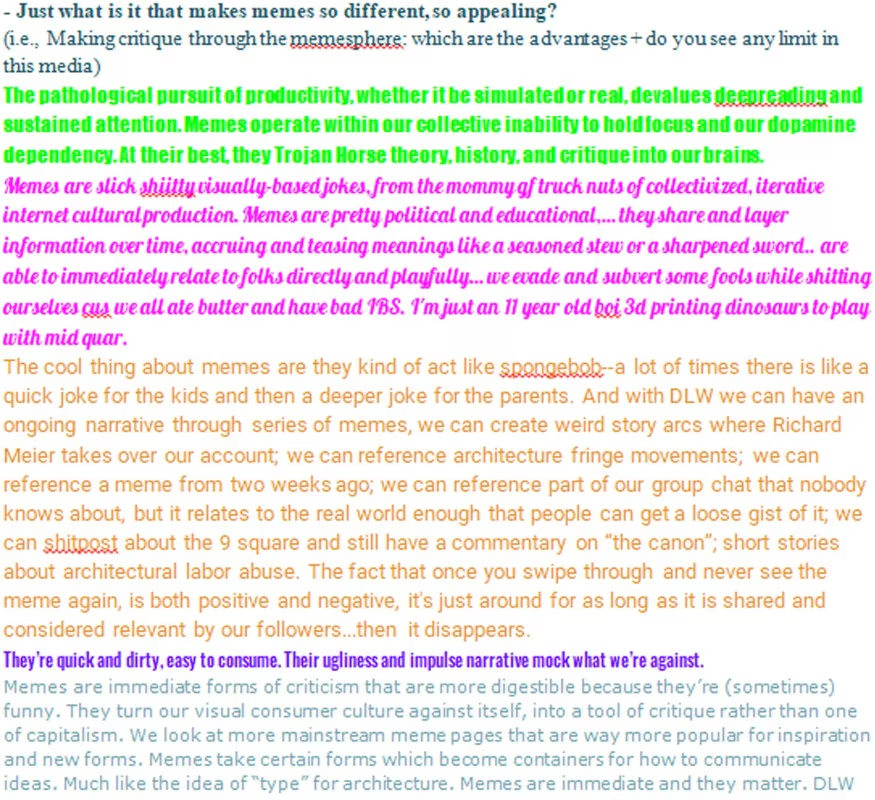
“A typical interaction with Dank Lloyd Wright's collective”. See note 19.
“Una tipica interazione con il collettivo di Dank Lloyd Wright”. Si veda nota 19.
The phenomenon of critical design memes, in particular, owes much to school dynamics. It is within the walls of educational institutions (universities, academies, master’s programmes, workshops) that these practices have found fertile ground. Anonymity, visual immediacy and irony allow students to articulate forms of dissent that are difficult to express in official contexts, bringing to light inequalities, curricular tensions and broken promises. As documented by designer and author Silvio Lorusso through blogs, articles and the book What Design Can’t Do20, many of the most significant cases come from Northern Europe, i.e. from contexts where the gap between critical aspirations and material conditions has become particularly evident.
Il fenomeno dei design memes critici, in particolare, deve molto alle dinamiche scolastiche. È tra le mura delle istituzioni educative (università, accademie, master, workshop) che queste pratiche hanno trovato terreno fertile. L’anonimato, l’immediatezza visiva e l’ironia consentono a student3 di articolare forme di dissenso difficilmente esprimibili nei contesti ufficiali, portando alla luce disuguaglianze, tensioni curricolari, promesse mancate. Come documenta il designer e autore Silvio Lorusso attraverso blog, articoli e il volume What Design Can’t Do20, molti dei casi più significativi provengono dal Nord Europa, ovvero da contesti in cui la distanza tra aspirazioni critiche e condizioni materiali si è fatta particolarmente evidente.
During the pandemic, this movement intensified. With the closure of physical spaces, meme pages have become, as Lorusso tells us first-hand, places of community capable of “maintaining, if not producing, a sense of belonging”21 at a time of total dematerialisation of the school. In the absence of the classroom, the meme has taken on the role of discursive infrastructure: fragile, ephemeral, but surprisingly effective in giving visibility to the structural problems of design education.
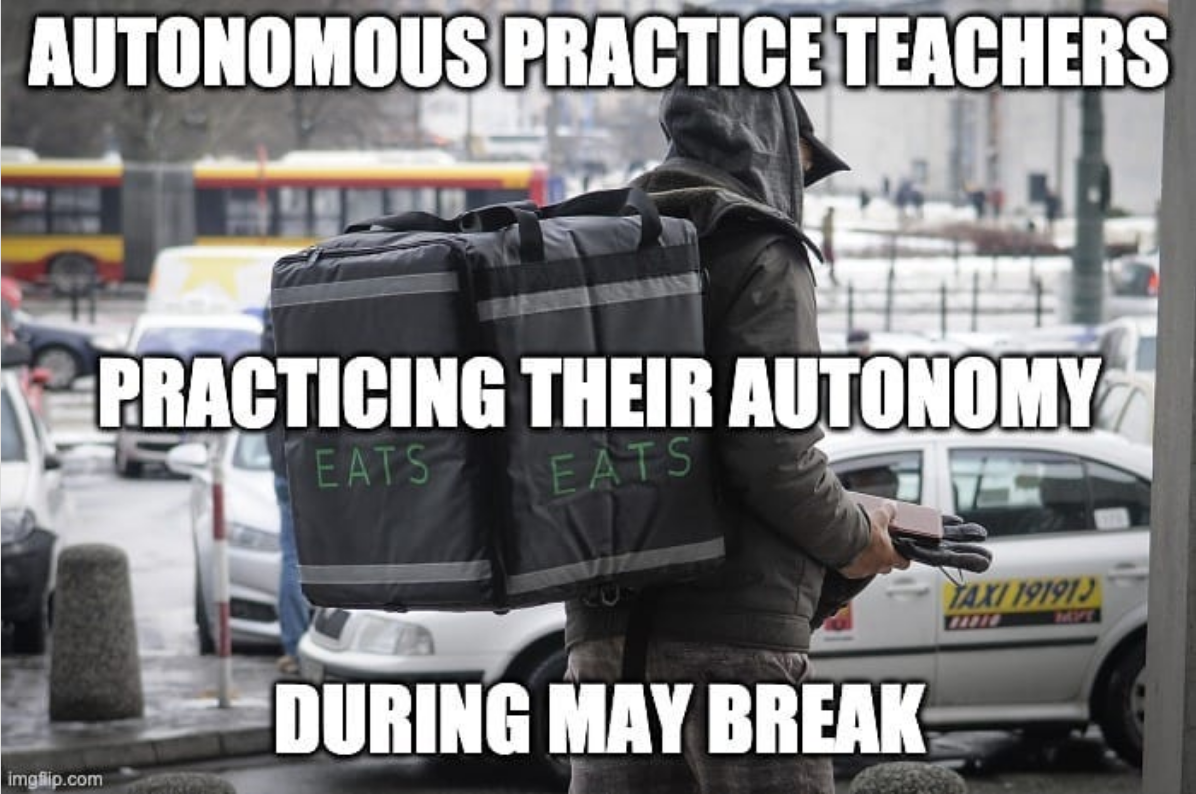
Image by @wdka.teachermemes. See note 21.
Immagine di @wdka.teachermemes. Si veda nota 21.
Durante la pandemia, questo movimento si è intensificato. Con la chiusura degli spazi fisici, le pagine meme sono diventate, come ci racconta in presa diretta Lorusso, luoghi di comunità capaci di “mantenere, se non produrre, un senso di appartenenza”21 in un momento di smaterializzazione totale della scuola. In assenza dell’aula, il meme ha assunto il ruolo di infrastruttura discorsiva: fragile, effimera, ma sorprendentemente efficace nel dare visibilità ai problemi strutturali dell’educazione al design.
This process should certainly not be idealised. Irony can generate a sense of belonging, but also polarisation; it can highlight contradictions, but also reduce them to slogans. Oversimplification and the risk of getting lost in the memetic jungle are always lurking. Yet it is on this set of ambivalences that the critical significance of the phenomenon plays out, in this perpetual oscillation between what it reveals and what it distorts.
Non bisogna certo idealizzare questo processo. L’ironia può generare appartenenza, ma anche polarizzazione; può illuminare contraddizioni, ma anche ridurle a slogan. L’ipersemplificazione e il rischio di smarrimento nella selva memetica sono sempre in agguato. Eppure è su questo insieme di ambivalenze che si gioca il significato critico del fenomeno, in questa perenne oscillazione tra ciò che rivela e ciò che distorce.
And it is precisely in this intertwining of genealogies, fractures, postures and distortions that Meme Things First finds its place. The project attempts to make its way through the memetic jungle not to impose order (which, moreover, would be impossible) but to shed light on the voices that run through it, on the forms of criticism it makes visible, on the tensions it brings to the surface. If First Things First represented a point of condensation for the critical demands of several generations, Meme Things First observes its resonances in the digital present: it listens to what creeps in between irony and disenchantment, between political aspiration and material precariousness, and brings it to the table for analysis as an integral part of the history (and self-awareness) of contemporary graphic design.
Ed è proprio in questo intreccio di genealogie, fratture, posture e distorsioni che si colloca Meme Things First. Il progetto tenta di farsi strada nella selva memetica non per imporre un ordine (il che, d’altronde, sarebbe impossibile) ma per fare luce sulle voci che la attraversano, sulle forme di critica che essa rende visibili, sulle tensioni che porta in superficie. Se First Things First ha rappresentato un punto di condensazione per le istanze critiche di più generazioni, Meme Things First ne osserva le risonanze nel presente digitale: ascolta ciò che si insinua tra ironia e disincanto, tra aspirazione politica e precarietà materiale, e lo porta sul tavolo dell’analisi come parte integrante della storia (e dell’autocoscienza) del graphic design contemporaneo.
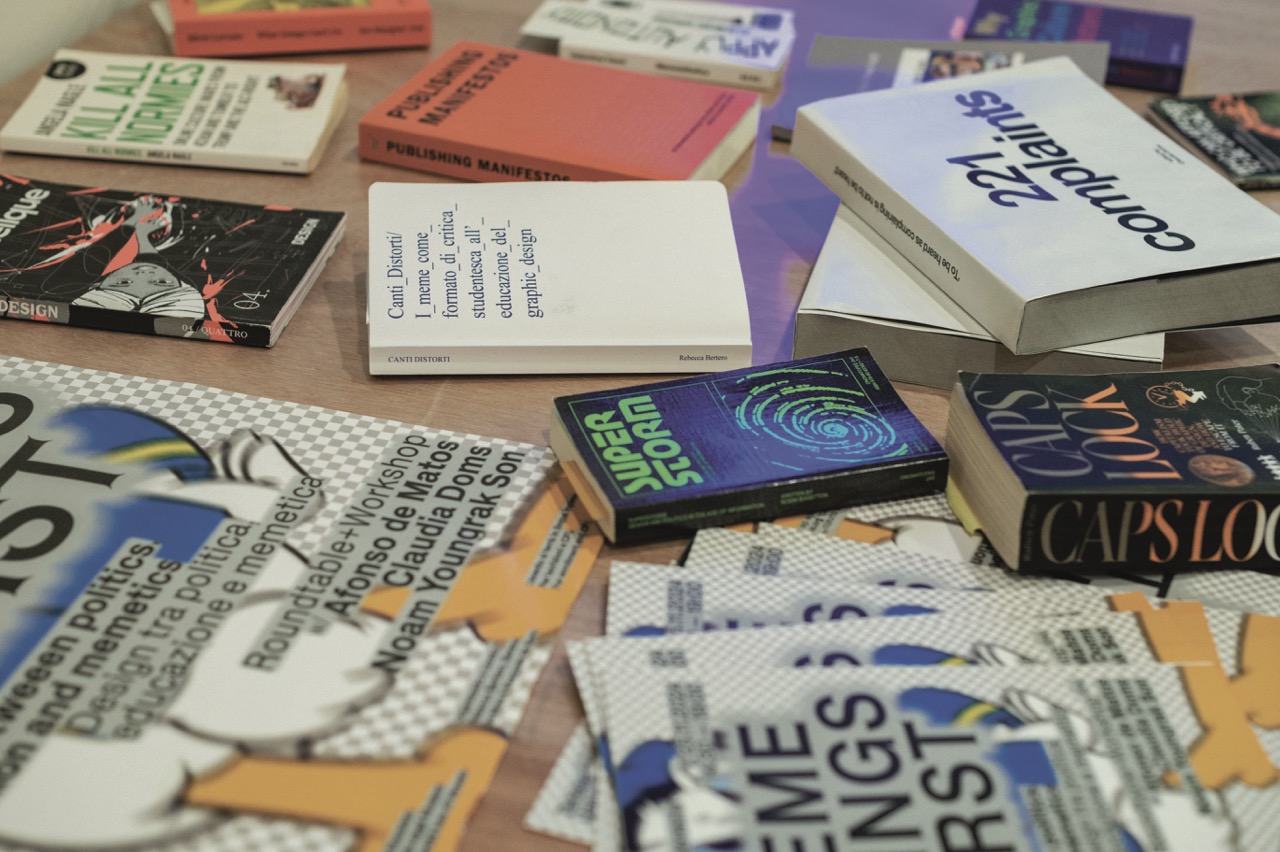
A photo from the seminar. © Olesea Bojinov.
Una foto del seminario. © Olesea Bojinov.
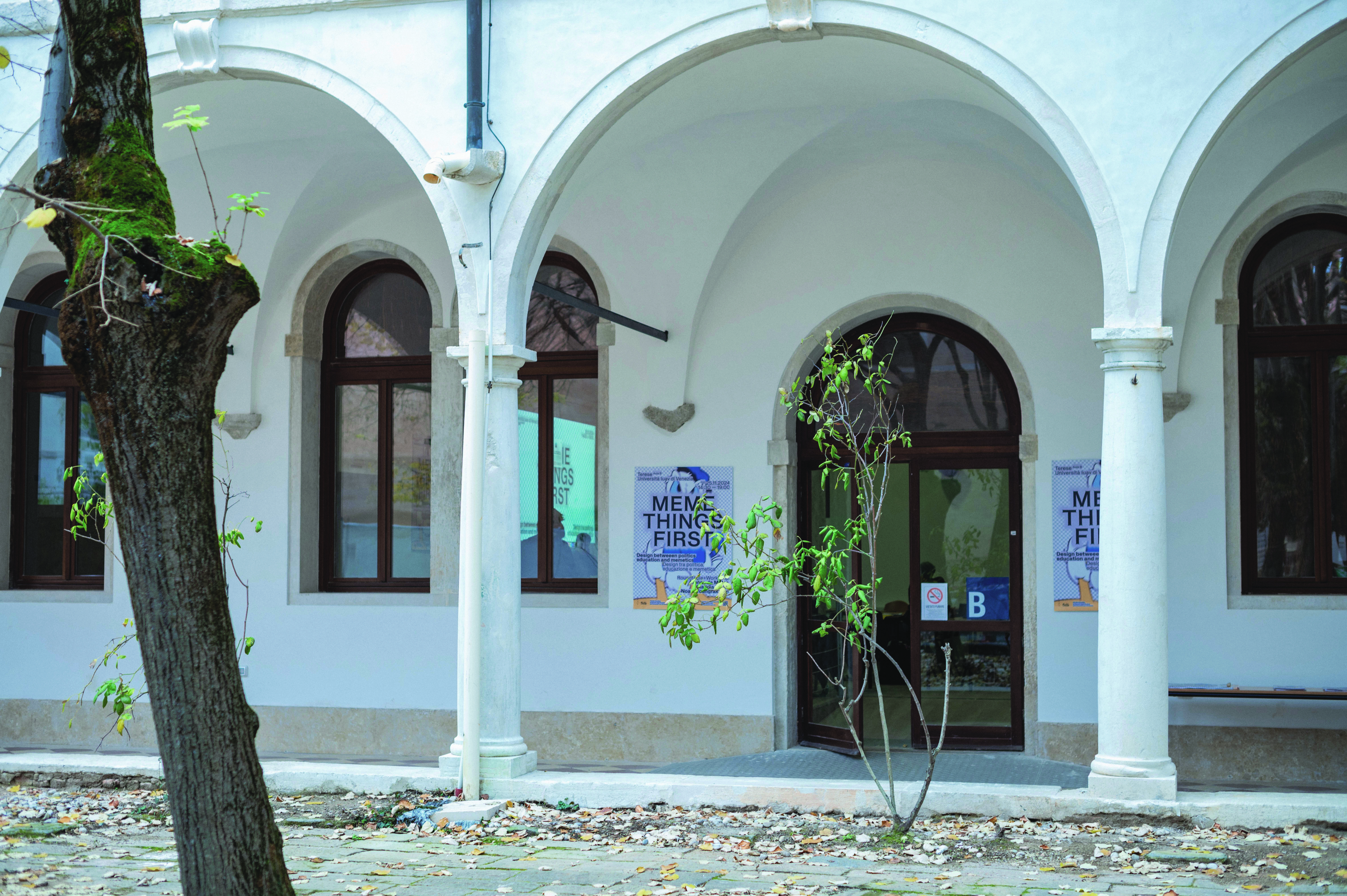
The seminar held on November 25th, 2024, in the cloister of the Terese at the Iuav in Venice, fits into this approach, and this volume provides a trace of the event.
In questo spirito si inserisce il seminario del 25 novembre 2024, che ha avuto luogo nel chiostro delle Terese dello Iuav di Venezia e di cui questo volume restituisce la traccia.
In the first part of the day, lectures by designers and researchers , and focused on three intertwined aspects of the same issue: the formats that the discipline fetishises, the material conditions that support its promises, and the political and logistical infrastructures within which design is continually put back to work. shifted the focus to the systemic conditions that link education, speculation and extractive logic, playing with the paradoxical figure of Art School™ as a financial machine that invests in the bodies and biographies of students. Between Monsanto soy, the tokenisation of identities and logistical infrastructures, design appears as a point of transition between the margins and the centre, between images and capital, but also as a space where it is still possible to practise forms of strike, sabotage and unexpected alliance. brought the discussion back to the classroom, starting with her project 221 Complaints: an investigation into unfulfilled expectations and fragile economies that mark the transition from school to work. What emerges is a picture in which design education still fuels the image of creative autonomy, while most careers are based on a combination of precariousness, parallel jobs, family or class capital. Finally, traced the line that connects memes and posters as two privileged objects of design discourse, showing how both function less as instruments of transformation and more as surfaces onto which graphic design projects desires for autonomy, critical postures and revolutionary fantasies.
Nella prima parte della giornata, le lecture dei designer e ricercatori , e hanno messo a fuoco tre piani intrecciati della stessa questione: i formati che la disciplina feticizza, le condizioni materiali che ne sostengono le promesse, le infrastrutture politiche e logistiche entro cui il design viene continuamente rimesso al lavoro. ha spostato lo sguardo sulle condizioni sistemiche che legano educazione, speculazione e logiche estrattive, giocando con la figura paradossale della Art School™ come macchina finanziaria che investe sui corpi e sulle biografie degli studenti. Tra soia Monsanto, tokenizzazione delle identità e infrastrutture logistiche, il design appare come un punto di passaggio tra margine e centro, tra immagini e capitale, ma anche come uno spazio in cui è ancora possibile praticare forme di sciopero, di sabotaggio, di alleanza imprevista. ha riportato la discussione all’interno dell’aula, a partire dal suo progetto 221 Complaints: un’indagine sulle aspettative disattese e sulle economie fragili che segnano la transizione dalla scuola al lavoro. Ne emerge un quadro in cui l’educazione al design alimenta ancora l’immagine dell’autonomia creativa, mentre la maggior parte delle carriere si regge su una combinazione di precarietà, lavori paralleli, capitale familiare o di classe. Infine, ha risalito la linea che unisce meme e manifesti come due oggetti privilegiati del discorso progettuale, mostrando come entrambi funzionino meno come strumenti di trasformazione e più come superfici su cui il graphic design proietta desideri di autonomia, posture critiche e fantasie rivoluzionarie.
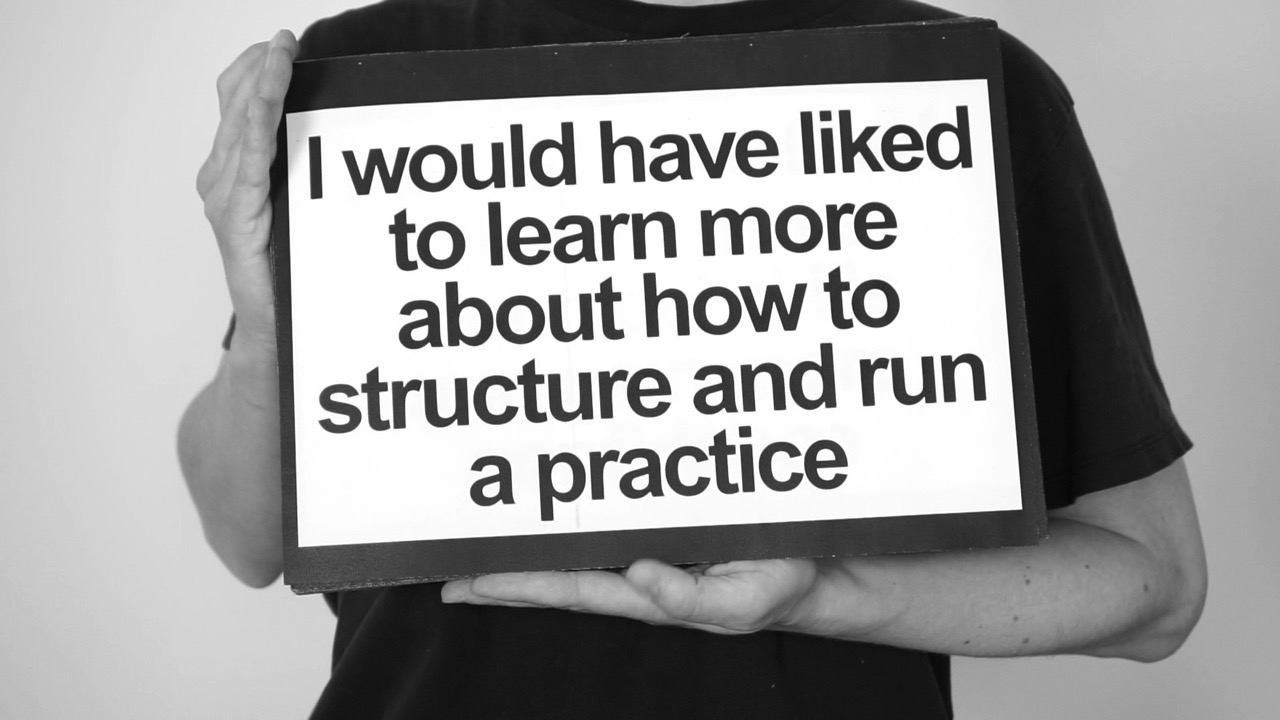
An excerpt from 221 Complaints by Claudia Doms.
Un estratto da 221 Complaints di Claudia Doms.
The second part of the seminar was dedicated to the 「MemeManifestos」 workshop, co-designed with Afonso de Matos, which involved students from the Iuav’s Bachelor’s and Master’s degree programs in Design and Arts. The task was not to learn how to design memes, nor to update yet another programmatic manifesto: rather, it was to use this hybrid format to shape their critical demands and measure from within the contradictions of their education, professional fantasies, disorientation, and frustrations. The posters produced, collected in the second part of the volume, give substance to a critique that does not come across in the high tone of the programmatic text, but in the minimal twist of a template, a crooked caption, an inside joke that ceases to be mere complicity and becomes, in its own small way, a political statement.
La seconda parte del seminario è stata dedicata al workshop 「MemeManifestos」, coprogettato insieme ad Afonso de Matos, che ha coinvolto l3 student3 delle Lauree Triennali e Magistrali in Design e in Arti dello Iuav. Il compito non era quello di imparare a progettare dei meme, né quello di aggiornare l’ennesimo manifesto programmatico: si trattava piuttosto di usare questo formato ibrido per plasmare le proprie istanze critiche e misurare dall’interno le contraddizioni della propria formazione, le fantasie professionali, il disorientamento, le frustrazioni. I poster prodotti, raccolti nella seconda parte del volume, danno corpo a una critica che non passa per il tono alto del testo programmatico, ma per la torsione minima di un template, per una caption storta, per un inside joke che smette di essere solo complicità e diventa, nel suo piccolo, enunciazione politica.
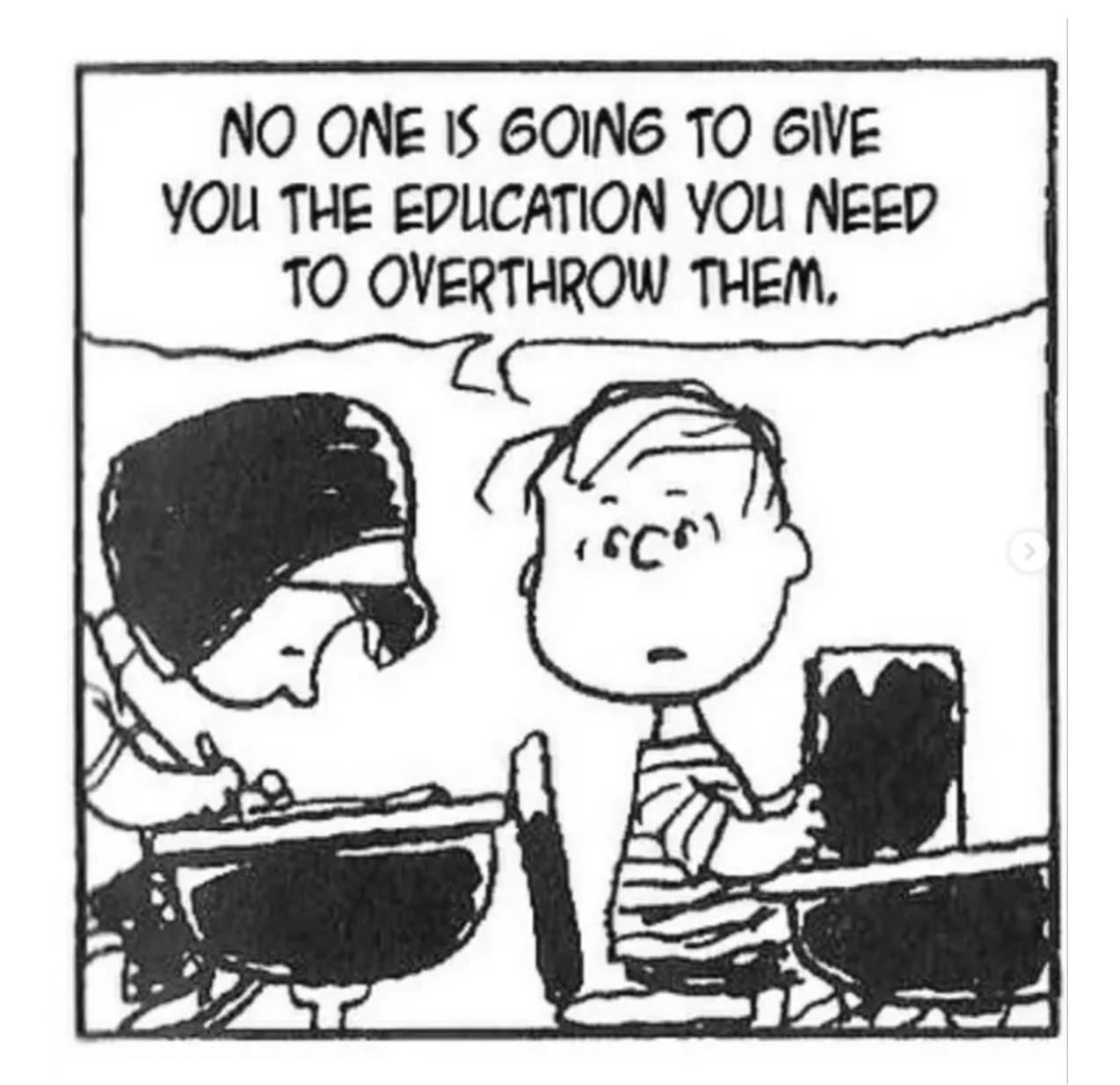
Peanuts’ strip, Charles M. Schulz, found image.
Vignetta dei Peanuts, Charles M. Schulz, immagine trovata.
This text is an excerpt from the publication collecting contributions from the seminar and workshop Meme Things First held at the University Iuav of Venice on November 25, 2024.
Questo testo è un estratto della pubblicazione che raccoglie i contributi del seminario e del workshop Meme Things First svolto all’Università Iuav di Venezia il 25 novembre 2024.